
Suffer Suffer for Suffrage
Let’s Widen Our Lens 💡

“You always told me it takes time.
It has taken my father’s time, my mother’s time, my uncle’s time, my brothers and my sister’s time, my nieces and my nephew’s time—how much time do you want for your progress?”
The first time I stood in line with my mom to cast my ballot vote, you couldn’t tell me nothin’. It was an unseasonably warm day in Gwinnett County, Georgia—maybe April, maybe May and hundreds, maybe even thousands of us Georgians congregated in lines outside of a white warehouse. Once I’d chosen my candidates and placed my vote in the designated repository, I walked out like I’d single-handedly affected/changed the course of history. I was beaming in total reverence of my trailblazing ancestors. Understanding what it had taken to get to where I, an 18-year-old Black girl born of two African immigrants, could stand tall in my autonomy of choice, filled me with an unending gratitude.
Black people in America have spent roughly 250 years fighting for suffrage: the legal right to vote in public, political elections. And of those 250 years, we have only had about 50 years experiencing it in its fullness.
For 94 years, from 1776 to 1870, the law explicitly excluded Black people from the democratic process. Voting was a privilege reserved only for white male property owners. If you remember from last week, the 3/5ths compromise—which counted three out of every five enslaved persons for federal representation—wasn’t officially overwritten until the ratification of the 14th Amendment in 1868. This amendment ensured that states could no longer claim political power based on a Black population they refused to grant the right to vote.
Black determination was at an all-time-high; by this point, we’d already endured 240+ years of legal oppression and wouldn’t stop now.
Of course as the United States grew, so did states’ rights. Individual states added laws to their constitutions that continued the prohibition of the Black vote. This was a deliberate extension of the pre-Civil War status quo into the post-war era aimed at ensuring Black Americans could not by any means exercise political power or influence the government. The government still wanted living property.
In 1870 though, the 15th Amendment was ratified, granting Black men the right to vote. On March 31st of that same year, Thomas Mundy Peterson became the first African American to cast a ballot under these new provisions.
Between 1865 and 1876, over 1,500 Black men held public office in southern state and local governments. They were state senators, lieutenant governors, and sheriffs. At the national level, 22 African Americans held seats in Congress between 1870 and 1901. However, white southern Democrats used violence, intimidation, and fraud to suppress these votes. After federal military protection ended in 1877, southern states rolled in poll taxes and literacy tests, turning gerrymandering to the max to bypass the 15th Amendment. Following the departure of Representative George Henry White in 1901, there were no Black U.S. representatives until 1929, and no Black U.S. senator until 1967.
What was a constitutional right was also a functional impossibility.
The paradox of America.
Black women continued the fight for suffrage through the early 20th century.
In 1871, Mary Ann Shadd Cary led 60 women to attempt to register to vote in Washington, D.C. In 1896, the National Association of Colored Women was established to link voting rights to racial equality. The 19th Amendment, which granted women the right to vote in 1920, didn’t mean states were yet okay with Black women in the election office. Due to our intersectional identity, as both Black and Woman, local and state disenfranchisement tactics continued.
With the turn of the mid-20th century, so did the “Second Reconstruction” emerge.
In 1944, the Supreme Court ruled in Smith v. Allwright that primary elections excluding Black voters were unconstitutional. So, by 1964, the 24th Amendment had banned poll taxes in federal elections; progress unlike anything seen before in the country.
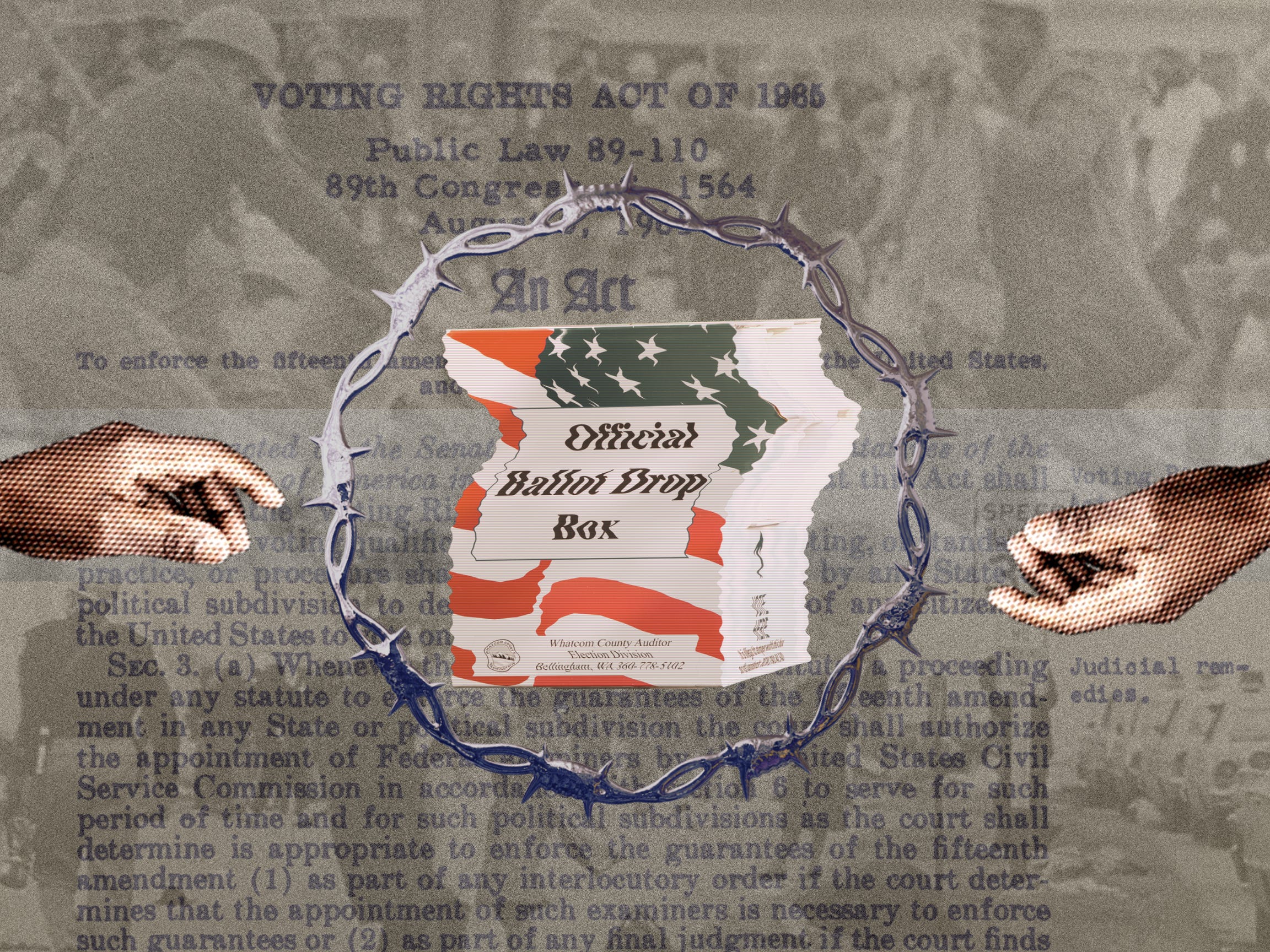
But catch this. On March 7, 1965, 600 marchers led by John Lewis and Hosea Williams attempted to walk from Selma to Montgomery. As they crossed the Edmund Pettus Bridge, Alabama State Troopers had already spread out to block their path. Upon refusing to disperse, the marchers were immediately sprayed with tear gas, brutally beaten with clubs and nightsticks, and pursued with whips on horseback. Captured by television cameras, the violence was said to have horrified the nation. This day, named “Bloody Sunday” increased public support and pushed the federal government to pen the Voting Rights Act of 1965.
By the early 1990s, Black political representation once again reached and even surpassed Reconstruction-era levels. However, in 2013, the Supreme Court case Shelby County v. Holder struck down key parts of the Voting Rights Act. Since 2008 (Barack Obama’s election), states have passed new restrictions, including voter ID requirements and limits on early voting. And, as of this past Wednesday, April 29th, the Supreme Court in the case of Louisiana v. Callais struck down a Louisiana congressional map a group of voters had challenged as the product of unconstitutional racial gerrymandering.
This key section, Section 2 , expresses that when electoral systems produce racially discriminatory results, they violate federal law. And under this section, a voting system is illegal if it results in Black voters having less opportunity than other voters to participate in a political process. There’s no need to prove that the lawmakers were "racist" or that they intended to discriminate.
Black residents make up roughly one-third of the population in Louisiana, a federal court found that a map drawn after 2020 only displayed one majority-Black district which obviously dilutes Black voting power. The legislature responded by drawing a second majority-Black district, as courts have required in similar circumstances.
The Supreme Court declared that district unconstitutional. They manipulated the Voting Rights Act by positing the creation of a majority-Black district as a violation of the Equal Protection Clause. By this understanding, the specific act of fixing a discriminatory map is itself labeled as illegal “racial sorting.” And by making the remedy for inequality unconstitutional, the Court ensures that those marginalized by disenfranchising maps continue to be barred out of access.
By a vote of 6-3, the justices left in place a ruling by a federal court that barred the state from using the map, which had created a second majority-Black district, in future elections.
Justice Clarence Thomas voted with the 6-3 majority to bar the use of this map. This vote is but another instance of a consistent pattern of decision from a man whose own life was revolutionized by the very civil rights advancements he now helps nullify. Thomas was afforded the opportunity to attend a liberal arts college and an Ivy League law school—access his rural upbringing in segregated Georgia would have never allowed—specifically because the Civil Rights Act forced open doors that had been padlocked for centuries. He leveraged that access to become the second Black man on the nation’s highest court, yet he now joins arms with those resolute in rolling back the protections that secured his success. In response to this, Justice Elena Kagan suggested in her dissent that the Court's current direction renders voting protections “all but a dead letter.”
I watched a TikTok by premisterlin:
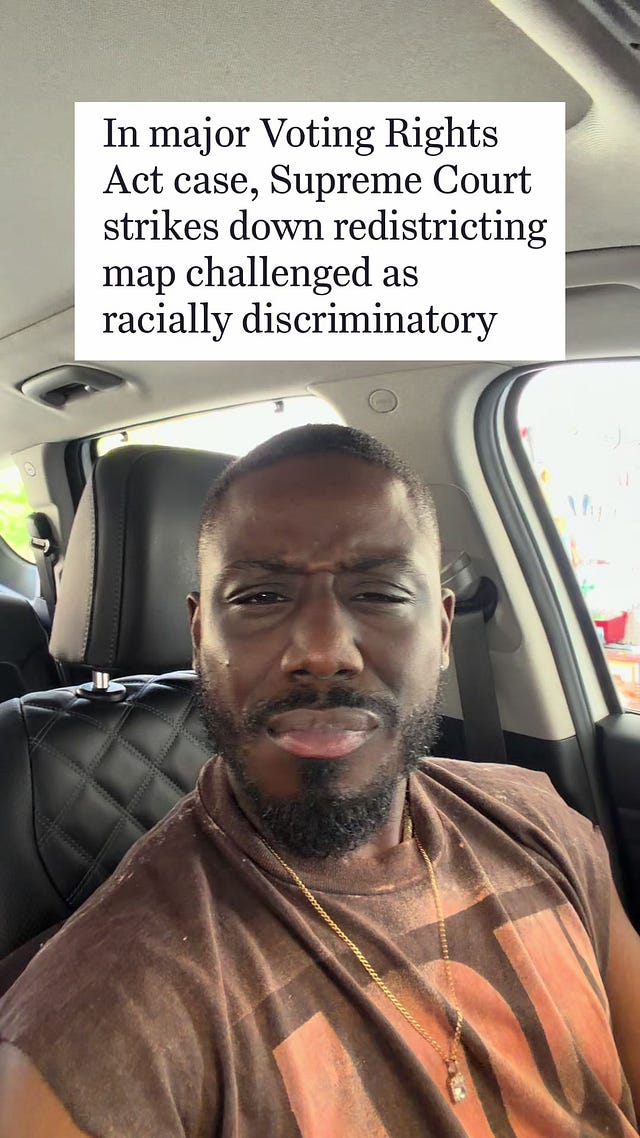
 Tiktok failed to load.
Enable 3rd party cookies or use another browser
on the Illusory Truth Effect which is a phenomenon where repetition increases belief in information. So, the more we see something in the news, online, or even (auditorily) by word of mouth, the more we believe it to be true. So in this case, the repeated assertion that our vote or actions are futile against a system that owns us, significantly contributes to our shared feeling of hopelessness; this is the literal root of learned helplessness.
I share a common belief that if the midterm elections, mutual aid, community development financial institutions (CDFIs), community boards, local committees, and independent media didn’t matter in the grand scheme of things, then there wouldn’t be so many attempts to dismantle them. This feeling of going back in time we feel concerning today’s legislative pressure does not mean our efforts are irrelevant, it means they actually work, and with congregations behind them, they really work!
So essentially the more we feel backed into a corner, the more room we have to do more—to anchor ourselves in our community and show up more. Which I see in my neighborhood and my friends, and the organizers I look up to.
Regardless of the powers that be, this world has always belonged to the masses—they’re called the elites for a reason. Societies throughout time have held some semblance of democracy, so I’m not going to let cynicism tell me, it just doesn’t work.
Always, always, remember there are more people that care, then don’t.
THAT’S fact!
P.S. Apologies for this dropping on a Sunday! I had an all-day Alumni event yesterday for an organization (WEST), I was president of (‘22-’23) and got to meet our founder! How cool is that?!
Anyways…

Written & Designed by Ife Giwa
Copyright © 2026 Perspective Network™. All rights reserved.
Questions? Email us at perspectivenet25@gmail.com
Tune in to Unsubscribe™ every Saturday for the latest news!