
In the heart of winter, I find within me an invincible summer
Let’s Widen Our Lens 💡

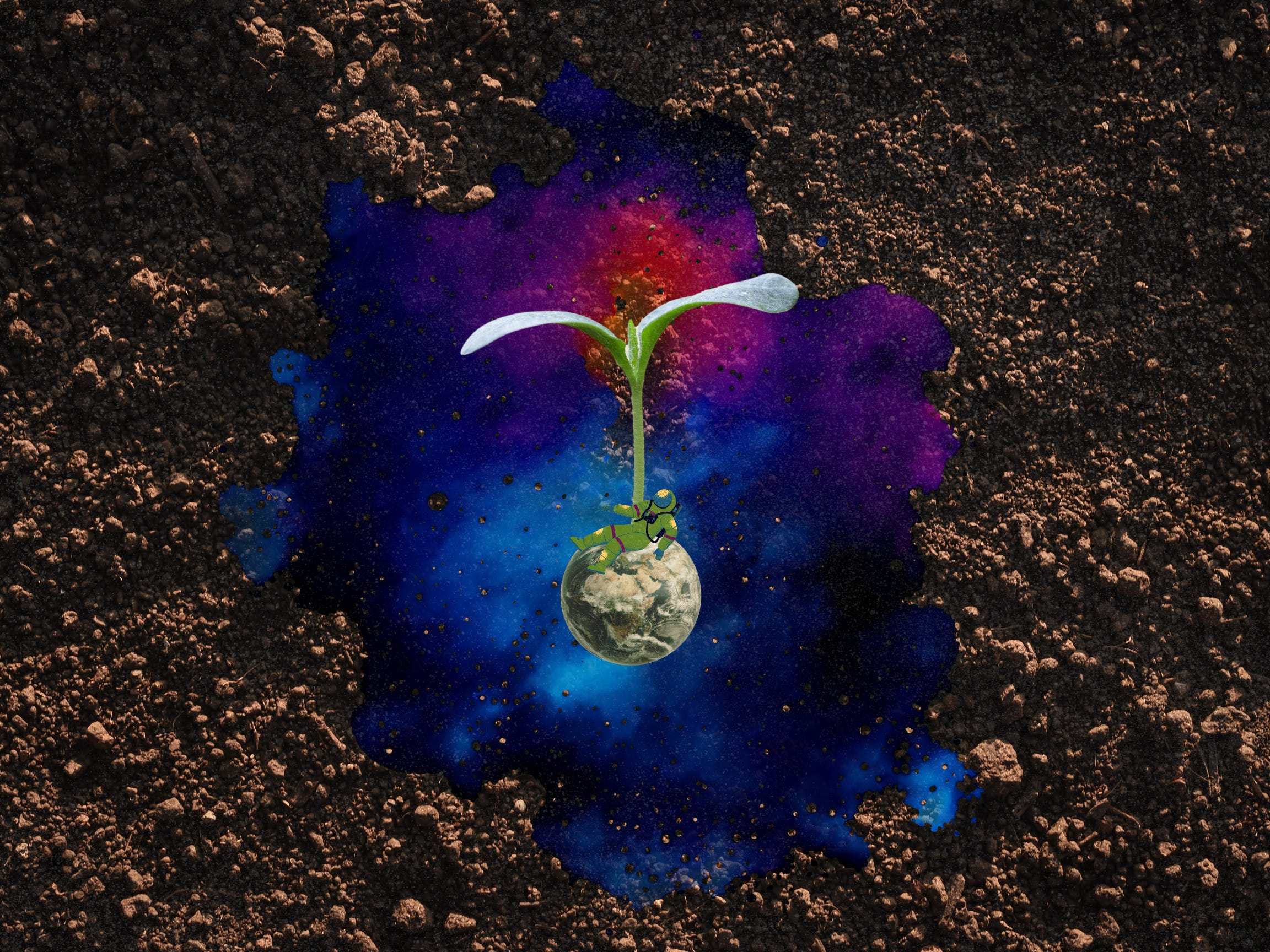
I think it’s quite empowering to give recognition to the geopolitical fatigue we feel as inhabitants of the Western world. If you watch the news or are plugged into social media—even part-time—you’ve likely felt, or consistently feel, this subconscious and underlying guilt and helplessness that just seems to overarch every moment of joy or quiet. And to be frank, it feels rightfully haunting; like this melancholy is the least we can be enduring in this present time. Our communities still retain a majority of their integrity. We can still recognize home, even as it wilts and weakens. But the awareness that this may not be true for long pervades. It whispers in the night and screams in the morning. And still, our sun rises.
I remember reading that following the Israeli airstrikes on oil storage facilities in Tehran (the capital city of Iran) and Karaj (an adjacent suburb) on March 7-8, black rain fell from an opaque sky. The air was reportedly unbreathable, burning skin and coating orifices. Their sun rose, unable to be seen in all its glory.
Because of a war the current American administration (arguably the last 11 administrations—think Eisenhower) in tandem with the Israeli administration (70 years of Afro-Latin-Arab Necropolitics) has deemed ordained by God, the entire world is either suffering from fuel or water depletion; a scarcity that threatens the future of our enduring biodiversity. All because these wicked men believe that
“God wills it”. Or as Pete Hegseth’s bicep reads, “Deus Vult” (a latin phrase that came out of the Crusades.)
I was thinking about the “Creation Story” according to major monotheistic texts (Torah, Bible, Quran) and stumbled upon a Twitter (X) thread on the Big Bang (a non-religious theory of our existence). The original post read, “If the Big Bang started everything, what existed before it?” To which a creator reposted and said, “It’s hard to conceptualize that beginnings and ends might strictly be a human experience.” The creator goes on to say:
“Time as a concept is only for human consumption. We use it as a tool, tools have parameters i.e. memory/references. But the concept is only applicative to what already existed before our consumption. Could it be that the universe simply has always been?”
To which someone (Mikael Koivukangas@KuviacM) responds,
“If the universe has always been, then you are living every moment of your life simultaneously… our life being a line is a hallucination, you’re already 90, and you’re still 1, and you’re your current age, at the same time. You’re already dead, and you’re still unborn. “You” are a spark that experiences “your life”, but everything has already happened.”
In continuity with this, I want to draw on David Elikwu’s exploration of the “African Time Paradigm,” where time is not a linear segment with fixed points, but rather a cyclical, orbital structure. Elikwu illustrates this relationship through two Swahili concepts:
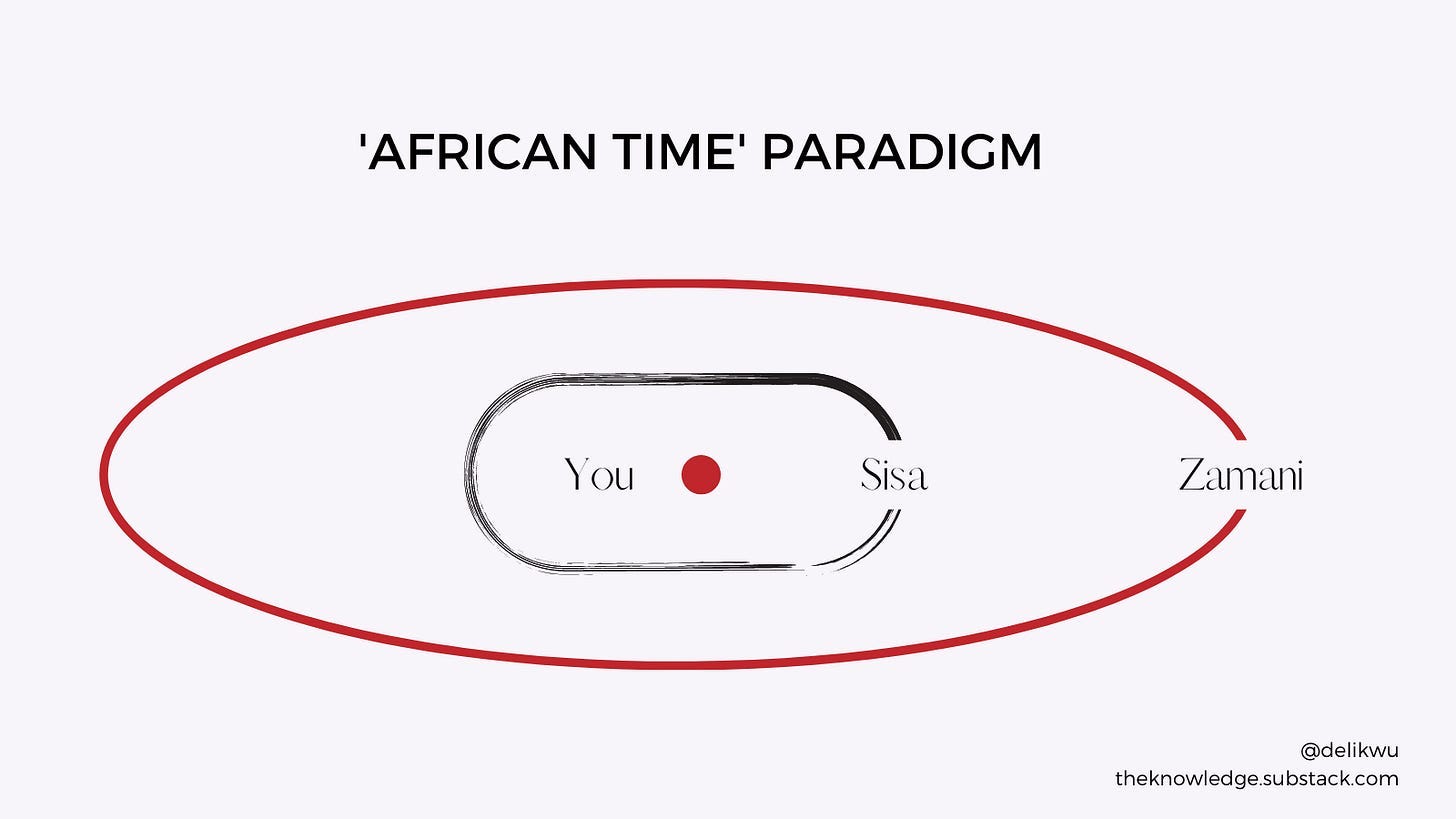
Sisa (micro-time) and Zamani (macro-time). Sisa is the immediate, experiential orbit—the present, near past, and near future within touching distance. Zamani is the boundless, encompassing expanse of existence. Rather than moving forward on a straight line, events are first actualized within the immediate sphere of Sisa before continuously cycling outward to be absorbed by Zamani. In this orbital framework, Zamani surrounds the present entirely; it is both an endless horizon of possibility and the final “ocean of time” where all phenomena are ultimately stored into reality.
Stay with me.
Now, the monotheistic calling (excluding Jews) to evangelize up until the rapture functions on the precipice of an approaching end of the world, and thus all life as we know it. End times prophecy, or Eschatology as some call it, provides an opposite end to the creation story; like the start of the world, there will be an end to the world. Grounding back in American history, after gaining independence from the British, American colonists sought to (as their name denotes) colonize a new land (one that Native Americans already inhabited). I’m by no means trying to insinuate the chicken came before the egg, but when you think about the massacre of indigenous communities, the enslavement of Africans, and all other historical (non-exclusive) American horrors, it’s important to remember that the psyche (the mind) is a fragile place; a catacomb that knows all its skeletons by name. So when you think of the kind of violence and atrocities the European colonists brought against others, you must think of what they used to cope. What kind of state of mind would justify such behavior? I’ll tell you: a mind convinced it is indefinitely at war. As described by General William T. Sherman of the American Union (1861), “War is Hell” And the word, calls you to bring this hell down upon your enemies.
Fast forward to the present administration (America in cahoots with Israel) built on the basis that the (and I say this in quote) once great, Christian American Empire is under attack (perpetual war phenomenon) and needs to be defended by any means necessary. Under those conditions, I can imagine any violence to be sanctioned as necessary, as the means to an inevitable end.
In presenting a juxtaposition to European time based on the African concept of time, there is no definite beginning or definite end. And we surely, as one of the trillion species existing on Earth, cannot unilaterally bring it to an end. We do (in attempts to satiate a bottomless pride) wield tools of destruction to exercise our extreme power, but still, we are not immortal to the consequences of our misdeeds. So is there truly an end or have we magnified the end of our species specifically to be thee end. I think we all had similar thoughts during Covid when we were on mandatory lockdown. We saw flora and fauna flourish without human intervention. It was like we were witnessing a world reborn.
Now it is 2026, and we are again witnessing a world reborn. One marked by conditions that only seem to worsen but may subsequently give way to a new society entirely.
I’m reading Parable of the Sower by Octavia Butler (1993) and am resonating with so much of the main character Lauren Oya Olamina’s ideas. Toward the beginning of the book she writes:
We do not worship God
We perceive and attend God
We learn from God
With forethought and work
We shape God.
In the end, we yield to God.
We adapt and endure,
For we are Earthseed
And God is Change
Now the book takes place in a post-apocalyptic drought-stricken California where climate change, extreme poverty, and drug-related violence have eroded society beyond what those of us who’ve never lived through societal collapse can even conceptualize in the present. So when she says “God is change” she expresses the understanding that God is shaped by we who are shaped by circumstance. God is a resource here but has no definite form.
As the world changes, our understanding of God, and thus time, will too. And as Lauren’s world, already far from what today’s looks like, falls apart to bear another, she notes that our nature is to adapt.
That reasoning has been giving me back my power. We can be like all these other plants and animals we watched thrive during lockdown if we only allow ourselves to turn toward change rather than wading against it. There is no ideal world in need of restoration, we (the people) are that world. As Lauren puts it, we are Earthseed, and “…the Destiny of Earthseed is to take root among the stars.”
When I read this at first, I was scared because I couldn’t logically comprehend humans living in space. But then I looked at it figuratively (which is arguably the way to interpret every philosophical/theological text) I understood it to mean that we must make ourselves comfortable with leaving what we know behind as we are propelled toward new life. And that is scarily vast, open, dark, and bright—but comforting in its freedom. Like space.
Lauren urges her community to prepare for change, as her chronicling of life indicates will happen no matter what. They obviously respond in fear, depression, and apathy, but continues in hope (a grounded hope). She prepares a go-bag in the eventuality of change and when it comes, she is ready for it, she need not fight it.
This is what I aim to find creative ways to share with my community.
Methods of preparing for change. Whether that’s preparing a go-bag, borrowing books about edible plant life, or taking a class on finding shelter and temperature control in crisis, you should be engaging with the idea of living off the earth. If time is cyclical and everpresent, then we may be due for a return to indigeneity.
But, as Lauren teaches in the book, there is nothing we seek that cannot be found and learned. Everything we will need to know about the Earth and surviving is already accessible to us. It’s just a matter of using it. So as I finish this timely read, I hope I’m left with an indelible confidence in my capacity to embrace change, and help my surrounding community do so as well. Arms outstretched, ready for liftoff.

Written & Designed by Ife Giwa
Copyright © 2026 Perspective Network™. All rights reserved.
Questions? Email us at perspectivenet25@gmail.com
Tune in to Unsubscribe™ every Saturday for the latest news!